Foam Is the New Canvas: How the Yeezy Slide Silhouette Is Reshaping Sneaker Design Everywhere
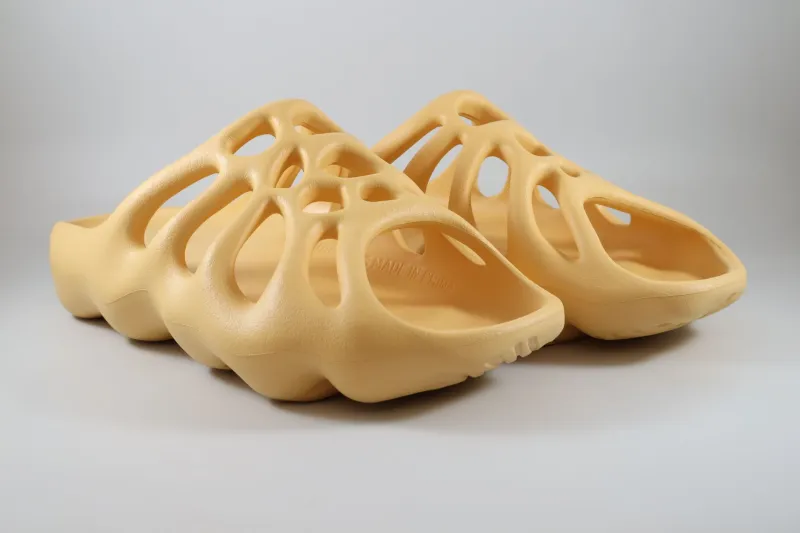
Design influence doesn't always announce itself. Sometimes a silhouette just starts showing up everywhere — in store windows, on Instagram feeds, in the back half of runway lookbooks — and you don't fully register what happened until you realize the whole landscape has shifted. That's exactly what the Yeezy Slide has done to the footwear industry over the last few years.
What started as a single-material foam slide with a sculptural heel tab and a deliberately minimal aesthetic has quietly become one of the most influential design references in the game. Not just for direct competitors or fast-fashion knockoffs, but for serious designers, established brands, and emerging collaborators who've looked at what Yeezy built and decided they wanted a version of that conversation for themselves.
The Design DNA That Started It All
To understand why the Yeezy Slide has had such a broad impact, you have to understand what actually made it different when it dropped. Before Yeezy Slides, the foam sandal category was largely utilitarian — think hospital clogs or beach shoes. Function-first, aesthetics secondary.
What the Yeezy Slide did was flip that hierarchy. The foam became the statement. The single-piece construction wasn't a cost-cutting move; it was a design philosophy. The thick, slightly exaggerated proportions and the sculptural quality of the silhouette made it feel closer to an art object than a sandal. It was comfort wear that took itself seriously.
That combination — minimalism with visual weight, casual function with luxury posture — turned out to be enormously influential. It gave designers a new template to work from: what does a shoe look like when you strip it down to almost nothing and still make it feel like something?
The Luxury Response: When High Fashion Discovered Foam
It didn't take long for the luxury tier to start asking that same question. Balenciaga, which has long had a knack for elevating utilitarian forms, leaned into foam and injection-molded construction with several silhouettes that owe an obvious conceptual debt to what Yeezy was doing. Their approach is different — more maximalist, more overtly strange — but the underlying logic of treating foam as a premium material is the same.
Bottega Veneta has explored similar territory with chunky, single-form footwear that prioritizes material quality and shape over ornamentation. Margiela's Tabi sandals and their various foam-adjacent experiments push in a related direction. None of these brands would necessarily point to Yeezy Slides as a direct reference, but the cultural permission to take foam seriously as a design material? That conversation has Yeezy's fingerprints all over it.
At a more accessible luxury price point, brands like Rick Owens and even some of the New Balance collaborator universe have experimented with slide-adjacent forms that borrow the same visual grammar — minimal upper, exaggerated sole, monochromatic execution.
The Collaboration Angle: New Voices on a Familiar Form
Beyond direct aesthetic influence, the Yeezy Slide has also opened up a broader conversation about what slide collaborations can look like. When a simple, single-material silhouette becomes culturally significant, it becomes a canvas — and that's attracted some interesting creative voices.
Within the Adidas ecosystem, various Yeezy Slides have been produced in partnership with artists and stylists who've influenced colorway decisions, limited regional drops, and campaign aesthetics. The creative latitude of a slide — fewer moving parts, less construction complexity than a sneaker — makes it a natural vehicle for color-forward or concept-driven collaborations.
Outside the Yeezy brand itself, brands like Crocs (which has its own long history with foam footwear) have leaned harder into collaborations that echo the same cultural energy — pairing a simple, polarizing silhouette with unexpected partners to generate heat. Post Malone, Bad Bunny, and a rotating cast of designers have kept Crocs relevant in a way that mirrors the Yeezy Slide playbook almost beat for beat.
The Inspired-By Economy: When Flattery Gets Complicated
Then there's the part of the conversation that's a little more complicated: the wave of slides that are clearly inspired by — or in some cases, pretty aggressively copying — the Yeezy Slide aesthetic.
Amazon, ASOS, and various fast-fashion retailers now carry foam slides that borrow the thick footbed, the sculptural heel tab, and the monochromatic colorway options that made Yeezy Slides iconic. These aren't counterfeits in the legal sense — they're not claiming to be Yeezy — but the design language is unmistakably derivative.
This is where the cultural influence gets messy. On one hand, widespread imitation is the clearest possible signal that a design has achieved genuine cultural penetration. On the other hand, it compresses the exclusivity that made the original feel special. When a $15 version of your aesthetic exists on Amazon Prime, the conversation about what makes the real thing worth $70 (or $150 on resale) gets more complicated.
For Yeezy Slides, the answer has largely been: scarcity, cultural credibility, and the specific energy of the brand itself. The foam is almost secondary. What you're buying when you buy a Yeezy Slide is a position in a cultural conversation that the knockoffs are adjacent to but not actually part of.
What This Means for the Sneaker Industry Going Forward
The broader takeaway from all of this is that the Yeezy Slide demonstrated something important to the entire footwear industry: simplicity can be a power move. In a category that's historically been defined by technical complexity — air cushioning, carbon fiber plates, multi-layer constructions — a single piece of foam managed to generate more cultural heat than most engineered performance shoes.
That lesson has not gone unlearned. Across the industry, there's been a noticeable shift toward silhouettes that lead with material quality and form rather than feature lists. The foam slide aesthetic has contributed to a broader moment where restraint is being revalued.
For the designers and brands paying attention, the Yeezy Slide isn't just a product to reference or imitate. It's a proof of concept — evidence that if you get the form right and the cultural positioning right, you don't need much else.
The foam did the talking. Everyone else is still catching up.